The Heinlein juvenile novels (they’d be called YA today) were my introduction into science fiction, much as the Hobbit was my introduction into fantasy. I have an enduring love of the books to this day. There are twelve main Heinlein juvenile novels, and Starship Troopers and Podkayne of Mars are frequently included in the list as well. Heinlein disagreed about Podkayne being on the list, though. I personally think Starship Troopers should be the one excluded, but I’m including all 14. Please note, this is entirely my own personal preference, others will have entirely different lists, I’m sure. I also tend to somewhat brush off the political subtexts in each book- they have very little to do with why I love the books, though I’m aware of them. Let me know how you order them, too. And from the bottom, with cover illustrations from the first editions…
 #14: Rocket Ship Galileo- 1947
I don’t care if it features Space Nazis, it’s still the weakest entry among the juveniles. That can largely be explained away by it being the first of them, though, so I suppose that is forgivable. Also, Space Nazis are a thing in it. The characters are extremely thin, it has Space Nazis, it uses that damn rich/genius/magical/whatever uncle trope to kick off the adventure, there are Space Nazis, and did I mention Space Nazis?
Okay, so I actually still like it a lot, even if it is the weakest entry in my opinion. They kill Space Nazis! Woo!
 #13: Starship Troopers- 1959
Seriously, were you expecting it higher? It’s good, but there are way, way too many moralistic speeches in it. It’s as John Galtian as a book can be without me hating it. It’s certainly not bad at all, it deserved its Hugo, but… Too many speeches, too little action. Also, remember that I’m judging it on YA criteria. It would be higher up normally, it’s just not great as YA in my opinion. I like it more reading it as a non-YA novel.
 #12: Between Planets- 1951
So forgettable. So very forgettable. Also, least proactive Heinlein juvenile protagonist. I mean, seriously, he does nothing, even during the climax. Everyone else does shit for him. URRGH. Okay, he’s not completely passive, he does do a few daring escapes on his own, fights in the swamps of Venus, etc… but still, he’s just not quite up to par. As should be noted with all of the books lower down on the list, though, it’s still really good, because Heinlein. (Except for late Heinlein. Beware Late Heinlein. Therein lies madness; also Stranger in a Strange Land.)
 Hellboy and the B.P.R.D. 1952 #1– Dark Horse
 Five Ghosts #14– Image
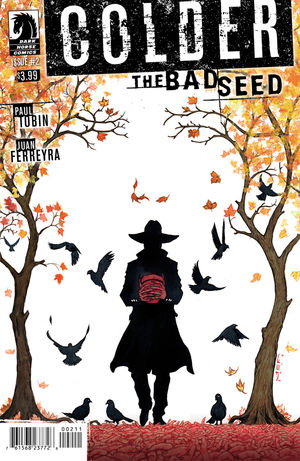 The original run of Colder, from 2012, was fantastic- it’s one of my favorite horror comics to this day, surpassed only by Locke and Key. About a former asylum inmate, Declan, whose body temperature grows slightly colder every day, it’s a twisted, horrifying tale exploring an otherworldly realm accessible only to the mad, and the horrifying beings who live there. Colder: The Bad Seed continues Declan and Reece’s story, with a terrifying new villian, Swivel, a well dressed, polite, demented, murderous thief of fingers determined to drag Declan back into madness, and planning on revealing his mysterious past. Juan Ferreyra’s art is as fantastic as ever, though the cover, while not bad, doesn’t hold up to the usual amazing standard of Colder covers. The story in The Bad Seed definitely feels a little slower, but the stakes are definitelty much higher. If you aren’t reading this one, you need to.
 I’ve been looking forwards to this one for a while. Matt Fraction is just getting better and better with every title, and Christian Ward’s art is a perfect complement. ODY-C is a gender-bent scifi retelling of the Odyssey. It isn’t a direct retelling, by any means, of course. Circe is recast as the Cicone, a civilization of mercenaries and barbarians plaguing the starways. The treatment of the recaptured Helen analogue is very, very different than in the original. There are a lot more differences, too. Fraction and Ward seem to be setting up the gods as the main antagonists in this- to be fair, the wrath of the gods, especially Poseidon, was the main source of conflict in the original, but they weren’t enemies- Odysseus was trying to earn back their favor. The gender-bending isn’t a direct male to female twist, either- there is a third gender, the sebex, as well. In fact, there is only a single male in existence in this universe, and that’s He, the Helen analogue. My only complaint is that Odyssia’s ship is actually called the ODY-C, which seems kinda self-referential to me, but that’s just a minor quibble. Overall, this is one of Fraction’s best debuts yet- I’d highly recommend it.
 Mountain Was Here