Author: mountainwashere

Nothing to see, move along.

Big, Scary, Evil Corporation of the Week

It’s Amazon.

If you don’t want to read through Charles Stross’ whole post, as well as the links therein: Amazon has been systematically tightening the screws on the big six large publishers, which is tightening the screws on the authors, even big ones like Robert Galbraith (J.K Rowling’s newest pen name). Last time Amazon did something like this, a number of brand new authors had their careers collapse into the gutter. No fun. The damage against the authors isn’t something the publishing companies are doing, by the way, it’s just fallout from the bigger fight. Amazon has 85-90% of the ebook market share right now, and a huge chunk of the physical book market. Calling it anything but a monopoly seems like a stretch at best. Hell, it’s worth five times any of the publishing companies it’s pushing around. (Give or take a few billion, not that Amazon would notice.)

Turns out free market capitalism kinda fucks over fiction writers, since their profit margins are so low anyways that when their customer-end distributor (Amazon) decides to profit at their expense, it starts driving them out of business. Thanks, Jeff Bezos! (Shockingly, a libertarian is using ruthless business practices that damage their own industry and suppliers in the long term in favor of short term profits on their end! Shocking. Oh well, I’m sure it’s a one time occurence.) (Despite my dislike of his business practices, he did found Blue Origin, which does give hims some points in my book).

What can we lowly peons do? Well, not much, other than buying our books and ebooks elsewhere.
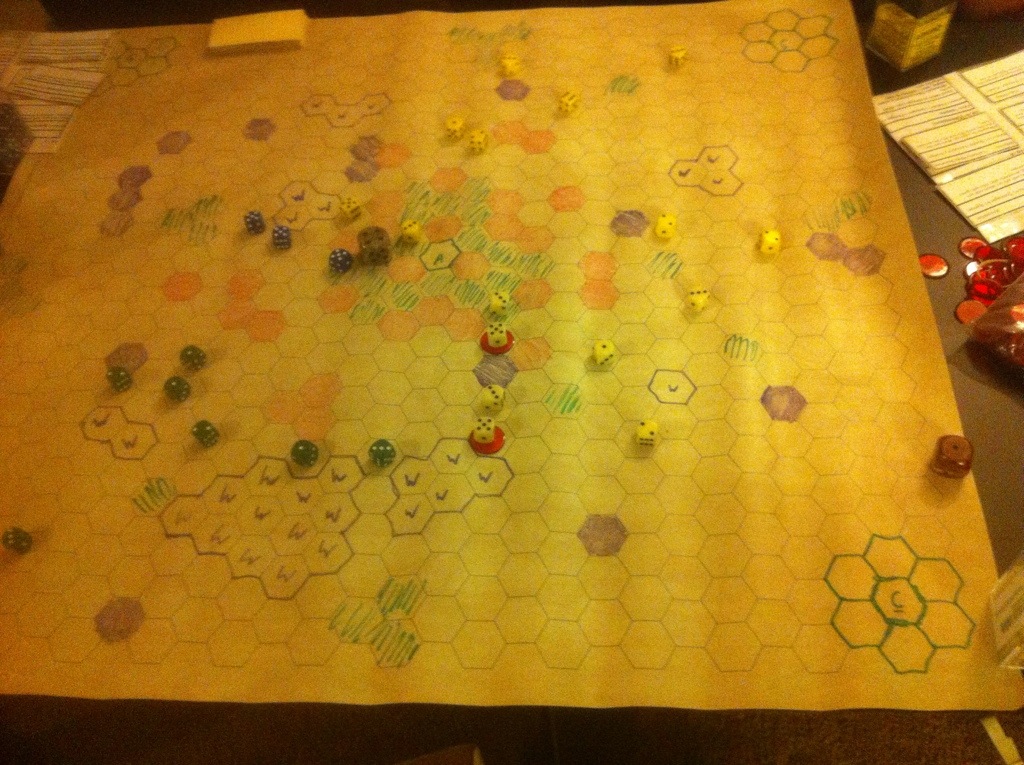
SiegeBeast Playtest

I finally did more playtesting on Siegebeast with some friends. I’m finally ready to unveil mechanics and such!

20140525-151431-54871781.jpg
SiegeBeast is a strategy game that uses dice for units. The key mechanic of the game is using the dice sides to keep track of life totals for each unit. There is no dice rolling at all in the game, except for choosing who goes first, or who gets a color of dice/ specific faction if multiple people want them. I’ve checked all over, and I haven’t been able to find any other games that use dice as units like this, I’m pretty proud of it. (I could be wrong. If you know of any other game that does this, let me know!)
(more…)

Great Hugo Readthrough 1960: Robert Heinlein’s Starship Troopers

First Readthrough/ Reread: Reread
Acquired: Owned

Other Nominees:
Gordon R. Dickson: Dorsai! (also known as The Genetic General)
Murray Leinster: The Pirates of Ersatz (also known as The Pirates of Zan)
Mark Phillips: That Sweet Little Old Lady (also known as Brain Twister)
Kurt Vonnegut: The Sirens of Titan
(more…)

A few brief thoughts on thought bubbles.

The 90’s have a lot to answer for when it comes to comics. One of the offenses committed then was the overabuse of thought bubbles. Thought bubbles had been slowly drifting into disfavor for decades, but after the 90s, thought bubbles became nearly taboo in the comics industry.

A major part of the problem was misuse of thought bubbles. They were used as exposition devices more often than not. Comics are one of the best places to show instead of tell, so characters explaining things to themselves that they already knew in their own thought bubbles gets annoying fast. It’s not as bad as the old “as you know” exposition, but it isn’t far off.

The loss of thought bubbles is just one of the many parts of the backlash against 90s comics, but it has survived some places, notably in Deadpool. The primary reason for their success there is the conversational tone they take. Batman and the Bat-Family also get away with it, usually through using thought bubbles to plan actions. (I should note that I differentiate between protagonists narrating a comic in their head and thought bubbles, they’re very different things in my book). So there are ways to do them well, and some comics have kept them alive. (Almost universally as rectangles, though).

And do you know what? I’m totally in favor of bringing them back more often- in the right scenarios. Just keep exposition in thought bubbles to a bare minimum.